Surgery planned around each patient,
with multidisciplinary care
Soft tissue surgery at S Animal Medical Center is about more than removing the lesion — our surgical plans take the patient's overall condition and any other illnesses into account. Veterinarians trained in surgery and anesthesia work with Diagnostic Imaging, Internal Medicine and Oncology to plan each case, and we perform a range of general surgery, including cardiac and bronchial stenting, urethral stone removal, PDA repair and tumor surgery.
Soft Tissue Surgery
-
01Interventional Procedures
Interventional Procedures
01Interventional Procedures
Stents & cathetersWhat are interventional procedures?
Interventional procedures are a minimally invasive way to treat narrowed or blocked vessels, airways and the urethra using stents and catheters. We assess the location and extent of the lesion with CT and other imaging, then place tracheal, urethral or vascular stents as needed.
Where stents are used
- 01Cardiac vessel stenosis A narrowed vessel around the heart can restrict blood flow and affect heart function. A stent is used to widen the vessel and restore blood flow.
- 02Bronchial stenosis A narrowed bronchus can interfere with breathing. A stent can relieve the narrowing and help restore breathing.
- 03Urinary tract stricture A stent can help urine pass through a narrowed urinary tract.
-
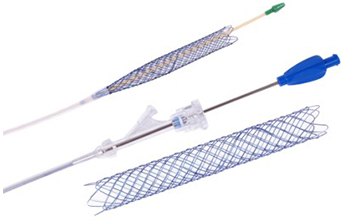 Nitinol stent
-
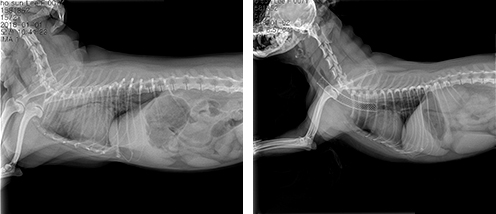 Before and after stenting
-
02General Surgery
General Surgery
02General Surgery
Urinary, hepatobiliary & gastrointestinalWhat is general surgery?
Our General Surgery service focuses on urinary, hepatobiliary and gastrointestinal disease. For bladder stones, ureteral obstruction, portosystemic shunt (PSS) and gastric dilatation-volvulus (GDV), the plan has to consider the whole patient and their organ function — not just the lesion. Through multidisciplinary care, we perform cystoscopy, multipurpose endoscopy, SUB and PSS surgery and other complex and minimally invasive procedures.
Nasal, urethral, bladder & airway endoscopy (minimally invasive)
A multipurpose endoscope lets us diagnose and treat in one procedure, with less pain and a smaller incision.
Cystoscopic holmium laser stone removal
Bladder stones are removed with a cystoscope inserted through a 0.5–1 cm incision and a holmium laser. The small incision and limited damage to the bladder lining help reduce pain and support a quick recovery.
Subcutaneous ureteral bypass (SUB) for cats
When a ureteral obstruction threatens kidney function, SUB creates a new drainage channel from the kidney to the bladder to preserve the kidney. We use the SUB 3.0 system.
Portosystemic shunt (PSS)
A congenital vascular anomaly that compromises liver function, treated after CT-based diagnosis and surgical planning.
Gastric dilatation-volvulus (GDV)
A classic gastrointestinal emergency that requires emergency surgery. Prompt diagnosis and 24/7 Emergency Surgery at our Ulsan hospital aim to restore the stomach's normal position and function.
-
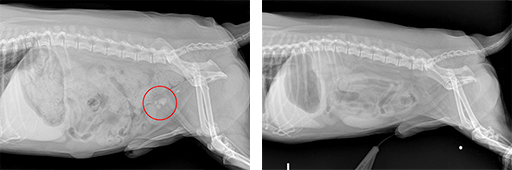 Radiographs before and after minimally invasive cystoscopic stone removal
-
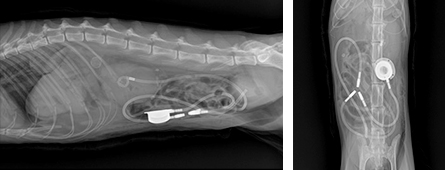 A 10-year-old cat with chronic kidney disease and a left ureteral stone, whose kidney values returned to normal after SUB placement
-
-
03Surgical Oncology
Surgical Oncology
03Surgical Oncology
Tumor surgeryWhat is surgical oncology?
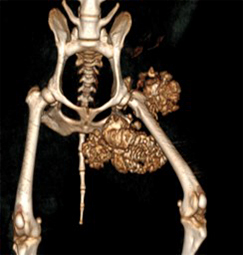
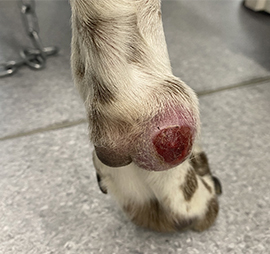
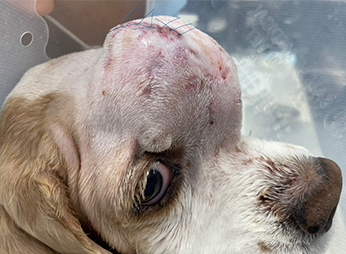
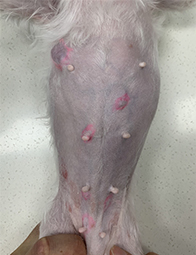
The right operation for a tumor depends on where it is, what kind it is and how aggressive it is. Before surgery we use CT and detailed testing to assess the tumor's extent and any invasion of surrounding tissue, and plan the resection margin for that tumor type. Through multidisciplinary care with Internal Medicine and S Animal Cancer Center, the plan can include chemotherapy and radiation therapy after surgery.
Our principles for tumor surgery
- 01Identify the tumor type The type and malignancy determine how much needs to be removed.
- 02Adequate margins Healthy tissue around the tumor is sometimes removed as well to reduce the risk of recurrence.
- 03Function and quality of life The plan considers not only removing the tumor but how your pet will function and live afterward.
- 04Follow-on treatment Chemotherapy and radiation therapy are coordinated according to the patient's condition.
-
04Thoracic Surgery
Thoracic Surgery
04Thoracic Surgery
Lung, heart vessels & chestWhat is thoracic surgery?
We perform surgery and interventional procedures for chest disease: lung tumors, lung lobe torsion, pneumothorax, mediastinal tumors, tracheal collapse and vascular stenosis. CT and other imaging assess the lesion before surgery, and veterinarians trained in surgery and anesthesia work together on treatment matched to the patient's condition, from minimally invasive tracheal and vascular stenting to complex operations such as lung lobectomy.
- Lung lobectomy
- Patent ductus arteriosus (PDA)
- Chylothorax (thoracic duct ligation)
Lung lobectomy
Part or all of a lung lobe is removed for severe lung trauma, lung tumors, lobe torsion or lung abscess.
Patent ductus arteriosus (PDA)
A congenital vascular defect in which a fetal vessel between the aorta and pulmonary artery fails to close, overloading the heart. The shunt diverts blood from the systemic circulation and can lead to left-sided or congestive heart failure; affected animals may avoid exercise or show cyanosis.
Chylothorax (thoracic duct ligation)
Caused by trauma, infection or tumors — or sometimes with no identifiable cause. Fluid collects in the chest around the lungs, making breathing rapid or labored.
-
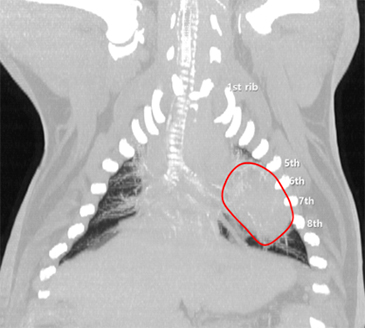 Lung tumor
-
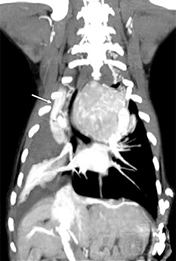 Lung lobe torsion
-
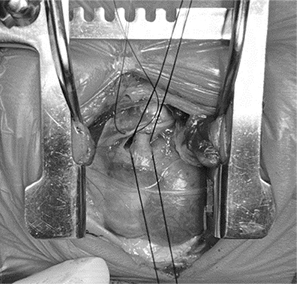 Locating and ligating the abnormal vessel (PDA)
-
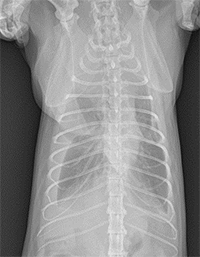 Chylothorax